How Urban Renewal Became a National Program
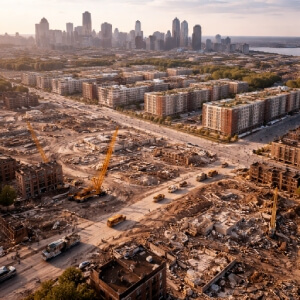
Signed into law by President Truman, the Housing Act of 1949 gave the federal government its most powerful instrument for reshaping American cities. The legislation authorized billions in subsidies for local redevelopment authorities, empowering them to acquire land through eminent domain, clear it, and sell it at reduced prices to private developers. The gap between acquisition cost and sale price was covered by federal funds, a mechanism critics later called a public subsidy for private profit.
The term "blight," essentially defined as the same in the local statutes of virtually every state, relaxed the standards for condemning those neighborhoods that were merely economically inconvenient rather than really uninhabitable. Thus, the blight classification was applied strategically by the mayors, business elites, and interests tied up with the downtown to justify clearance, with a more than a fair share of the outsized removal burden carried by black and low-income communities. Social scientist Herbert Gans presented this account as early as 1962, when the slum clearance process was called "slum clearance for the rich" in the context of the clearance of Boston's West End.
Famous Projects That Reshaped Cities and Removed Communities
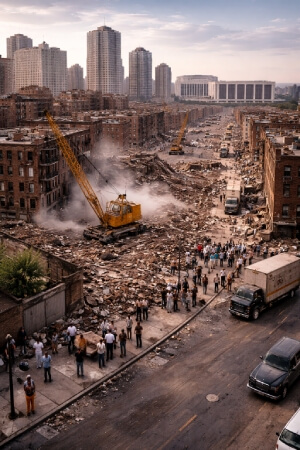
Three cases, separated by geography, reveal a consistent pattern: official redevelopment goals rarely matched the human reality on the ground.
Boston's West End was cleared between 1958 and 1960 under the banner of slum elimination. City planners demolished a dense, working-class neighborhood of roughly 7,500 residents, many of them Italian and Jewish immigrants. In its place rose luxury apartments and Massachusetts General Hospital expansions. Sociologist Herbert Gans, who studied the community before demolition, documented its tight social networks and concluded the "slum" label was largely a political instrument.
New York's Lincoln Square project displaced approximately 7,000 families and 800 businesses between 1955 and 1969, many from the predominantly Puerto Rican neighborhood known as San Juan Hill. Lincoln Center for the Performing Arts was built on that ground, celebrated nationally as a civic triumph while the displaced received inadequate relocation assistance.
Detroit's Black Bottom and Paradise Valley housed a thriving African American commercial district before the city demolished both neighborhoods through the 1950s. The Chrysler Freeway replaced them. Jazz clubs, churches, and Black-owned businesses that had survived segregation did not survive redevelopment.
The Legacy Still Shapes Urban Policy Today
Years after the bulldozers have stopped, the effects of the mid-century redevelopment programs keep being felt - and tracked. Black and Latino families displaced from neighborhoods like San Francisco's Fillmore or Chicago's Near West Side lost hard-won property wealth that was never recouped. Studies by the National Community Reinvestment Coalition suggest that, at its high point during the 1950s and 1960s, roughly 300,000 families annually were displaced by urban renewal, with communities of color bearing the bad end. The wealth gap deepens with subsequent generations.
Decades of deception, forced relocations, and broken promises by municipal executives have diminished public trust, making it more difficult for well-meaning redevelopment initiatives to draw support from citizens. Some places have taken steps to correct the past wrongs. For example, Evanston, Illinois introduced a municipal reparations program in 2021, aimed at compensating the beneficiaries of housing discrimination. In another instance, Oregon's Portland has pushed for the implementation of community land trusts to resist displacement in historic African American areas.
UMUAHIA URBAN RENEWAL AND BEAUTIFICATION CONTINUES BY ABSG
— New Abia (@GreatAbia) March 24, 2026
The Commissioner of Information, Prince Okey Kanu, has stated that the state government has thought it wise to install speed bumps on some of the newly constructed roads, roadside tree planting, landscaping of designated pic.twitter.com/Wf7orqHXtd
Undoing the damage of sweeping mid-century urban renewal on the near south side really ought to be a goal of this city. And I don't think mega projects are the answer here... https://t.co/m8bWFFA4Dd pic.twitter.com/TYV7dHkDCr
— Midwest Antiquarian (@Eric_Erins) April 2, 2026